Prostate Treatment: Therapeutic Walking, Running, and Swimming
Content updated in 2025–2026.

Important Advice from the Author
If possible, explore the site’s materials on a desktop computer, laptop, or all-in-one PC. This will make it much easier to view the site structure, navigate between sections, and fully absorb the content. It is also possible to use a smartphone, but due to the smaller screen size, some elements and navigation may be less clear. Information on prostate issues is presented here in a large number of articles, and each article contains only practical benefit — without unnecessary pages or intrusive advertising.
Walking, Running, and Swimming in Benign Prostatic Hyperplasia and Chronic Prostatitis
Question
How can one strengthen the prostate naturally? Which physical activity is most beneficial for benign prostatic hyperplasia — walking, running, or swimming? How does walking affect the prostate in men with urinary symptoms? To what extent are these forms of exercise effective for benign prostatic hyperplasia or for symptoms of chronic prostatitis? How compatible are running and chronic prostatitis, or running with BPH? Is swimming beneficial for prostate health? How important are these types of physical activity in prostate treatment, improving blood circulation and cardiovascular health, and are there any potential drawbacks that should be considered? Which exercises are most effective for maintaining prostate function and preventing progression of chronic prostatitis?
Answer
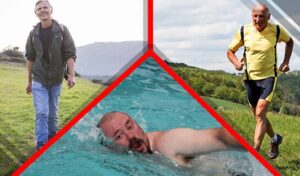
The Greatest Benefit Comes from Alternating Types of Physical Activity
The most effective approach to improving health in cases of benign prostatic hyperplasia and chronic prostatitis is a balanced combination of walking, running, and swimming. I base this conclusion on more than fifteen years of practical experience, during which I carefully analyzed my own actions, physical responses, and long-term outcomes — both after successful attempts and after ineffective ones. Later, I deliberately studied human physiology, the effect of structured exercise on the male urogenital system, and how physical activity influences prostate health. Therefore, everything stated here is well grounded and not theoretical. I will answer this question thoroughly, and I strongly recommend reading the entire article to gain a complete and correct understanding of exercises for men with BPH and chronic prostatitis.
Briefly about Physiology
Body movement is a continuous cycle of muscle contraction followed by relaxation. Proper execution is not innate, and if a person wants physical activity to truly improve health, the best results occur when the maximum possible number of muscles are engaged in a structured and controlled process, where contraction alternates correctly with relaxation. This principle is especially important for men dealing with benign prostatic hyperplasia or chronic prostatitis.
There are many persistent stereotypes surrounding therapeutic physical activity. Most people assume that walking on a treadmill automatically brings health benefits, while swimming in a pool is often perceived as an almost universal solution. In reality, without understanding how movement affects internal physiological processes, such assumptions lead to disappointment, weak results, and minimal improvement in prostate function or overall male health.
Today, many men attempt to improve prostate health through movement while living with BPH or chronic prostatitis. However, these efforts rarely become consistent habits — either because the results are weak due to insufficient knowledge, or because the effect is minimal. Very quickly, even a motivated person with health problems either abandons physical activity entirely or reduces it to a secondary role. The issue is not only the lack of progress, but also the fact that repeated failure often worsens an already difficult psychological and emotional state.
In such situations, patients are frequently misled by inexperienced or superficial medical advice. If such recommendations were limited to private consultations, the damage would be smaller. Unfortunately, many overconfident practitioners actively publish simplistic guidance online, overcrowding search results with low-value information. I have already noted on this site that if a physician diagnoses BPH, prescribes medications that suppress physical, chemical, and physiological processes, and simultaneously recommends therapeutic exercise, this contradiction should raise serious concerns. Medical institutions teach prescription protocols well, but provide little understanding of how to maintain — and especially how to restore — prostate health through movement, improve circulation, and strengthen cardiovascular function. This requires personal, long-term practice, not theoretical advice given from behind a desk.
There is also an opposing viewpoint. Its proponents claim that benign prostatic hyperplasia cannot be improved through physical activity — or cannot be overcome at all. When I ask such doctors a simple question — whether they have fully understood the complexity of the human body while sitting in a clinic — the discussion usually ends. I confidently state that BPH and chronic prostatitis can be treated effectively without side effects through a healthy lifestyle — more precisely, through properly regulated breathing combined with correctly structured movement and balanced nutrition. However, one essential component is indispensable: knowledge. Without it, meaningful results are impossible.
Below, I will consistently describe the advantages and disadvantages of walking, running, and swimming, and explain how each form of physical activity affects the prostate, blood flow, cardiovascular tone, urinary function, and overall male endurance.
Brisk Walking
Therapeutic walking for benign prostatic hyperplasia is accessible to the vast majority of people. Its advantages include a relatively gentle strain on the muscles involved, a beneficial effect on cardiovascular tone and blood circulation, and minimal risk of injury — damage usually occurs only through obvious carelessness. Walking also improves venous return and supports urinary function in men with prostate enlargement.
The drawback of walking for a prostate already burdened with problems is that, for many people, walking alone cannot raise the heart rate sufficiently, even with prolonged periods of faster walking. As a result, the overall tone of the cardiovascular system remains relatively low, providing only minimal therapeutic benefit. To maximize results, intervals of brisk walking should be combined with breathing exercises and posture awareness, enhancing prostate health and preventing the progression of chronic prostatitis.
Running
Running is highly beneficial for the prostate. It can be practiced even into the eighth decade of life, but proper preparation is, of course, necessary (though I am confident it does not need to be lengthy). Running is as beneficial for chronic prostatitis as it is for benign prostatic hyperplasia.
Advantages include the ability, under certain conditions, to most effectively activate the cardiovascular system and therefore, when paced appropriately, achieve a therapeutic effect.
Drawbacks include the risk of injury. This is not always due to carelessness. I once sprained a muscle in my ankle seemingly out of nowhere, stepping on a small depression in a concrete path while running. The injury was severe enough that I had to stop and switch to walking, unable to run for a while. Upon inspection, the height difference at the spot was no more than one centimeter. Simple advice: choose areas with smooth, well-maintained surfaces for running, avoid uneven terrain, and never run on ice. In general, be sensibly cautious.
Lack of basic knowledge can lead to even greater harm. A common example: many people develop issues with the spine and knee joints as they age, often accompanied by painful flare-ups, especially after excessive compressive strain. When such a person tries to improve health through running, most adhere to a fixed stereotype that only jogging is beneficial. Instead of running smoothly and cushioning parts of the body during different phases of motion to minimize stress on the spine and lower limb joints, they start running vigorously, shaking and relaxing muscles indiscriminately, often causing serious pain in problematic areas. Naturally, after such attempts, the individual is unlikely to continue exercising, and no one can convince them later that physical activity can restore health. They adopt a different stereotype: “This type of treatment is completely unsuitable for me.”
From long experience, it is impossible to fully predict the effects that exercise will have on the body. Many factors influence the final result: frequency and consistency of training, environmental conditions, and the condition of your body. Another drawback of running is that if it is the sole form of exercise, routine can eventually lead to stiffness in certain muscle groups. The body then requires a prolonged rest period, which is not always compatible with the therapeutic process.
Swimming is Incredibly Beneficial
Swimming engages specific muscle groups without overloading others. It goes without saying that a well-executed swim recruits the greatest amount of muscle mass. With proper technique, the cardiovascular system achieves excellent therapeutic tone—probably the most effective among exercises—while minimizing side effects. These are its advantages.
Drawbacks: The greatest danger is the risk of hypothermia. If the participant’s blood vessels go into a cold spasm, complications can arise, potentially worsening BPH. There are optimal limits for both time and water temperature. Ignorance of these can lead to problems. I once heard a story from an acquaintance about a friend who, while engaging in underwater hunting, experienced not only complications but also acute urinary retention requiring bladder catheterization. Naturally, after this, he abandoned the activity. The problem is that such accounts can easily mislead others, causing them to falsely believe that swimming is harmful.
Nature designed us so that almost every activity can provide benefit when the “golden mean” principle is applied. Underwater diving, however, is far from therapeutic. Immersion to a depth of one meter significantly increases external water pressure on the body compared to atmospheric pressure. At four to seven meters, as is common in underwater hunting, blood vessels experience a kind of hydraulic shock, likely causing increased blood pressure and strong vascular spasms. Furthermore, such activities do not require significant movement at depth; in most cases, one must either swim very slowly or remain still, increasing the risk of hypothermia, especially if the extremities are not adequately insulated.
Consequently, a person may experience problems from one type of activity and unfairly judge another, confusing harmful effects with beneficial ones. Unfortunately, swimming is not always accessible. Climate conditions may prevent year-round use of open water, water quality may be poor, and not every town has suitable pools, or they may be too expensive. Ideally, swimming should be done in a saltwater pool, as chlorinated pools are not suitable for everyone. In short, the main limitation of swimming is that access to it is restricted for many people.
Conclusions and Advice from My Personal Experience
I will quote the question posed: which activity is most beneficial for benign prostatic hyperplasia – walking, running, or swimming – and how effective are these exercises for BPH? Based on everything discussed above, I will summarize thoroughly and illustrate my answer with an example, as this approach helps information to be absorbed more quickly and effectively.
Here is how I proceed. Everything is naturally cyclical, and I will start with what I call the first day of my exercises. Today, for example, I give tone to my muscles and cardiovascular system using only running. My pelvic, thigh, hip, and lower limb muscles are fully engaged. This is beneficial, but the upper body is less involved, and improvement in circulation occurs only through a relatively small group of muscles.
Tomorrow, at the same time, I will go to the swimming pool. Exercising in water enhances circulation throughout the body by engaging both the upper and lower limbs, provided one swims correctly and uses muscular strength as fully as possible. Meanwhile, the muscles I worked yesterday operate in a much gentler mode. One could even say they are not overstrained, yet cardiovascular tone remains high because more muscles across the body are engaged in movement.
The next day involves alternating running and walking. For example, after a warm-up walk, I run with acceleration, then walk to recover my breath, followed by another acceleration, and so on, cycling as desired. In this case, the load on the lower body muscles is lighter than during continuous running.
The fourth day consists of brisk walking with accelerations, without running. The tone is moderate—not overloading, yet not idle. The following day, I perform a highly active session consisting solely of running (repeating the first day), thereby establishing a cycle with optimal types of activity. Weekend sessions are arranged according to personal well-being and energy levels. This schedule has minimal drawbacks, while the therapeutic effect, especially when combined with other measures, is very strong.
Clear harm from these types of activity is possible only in one well-known case: severe overexertion, resulting in soreness or muscle stiffness. I do not consider situations where thoughtless activity could, for instance, lead to heart failure—reasonable people generally avoid such extremes. Remember, the ultimate result of any correct physical activity is a sense of calm and well-being, joy, and the satisfaction of having benefited oneself.
I am confident that anyone familiar with the full scope of information on the site understands that success in treating benign prostatic hyperplasia, as with other illnesses, depends on adhering to a set of rules. I have repeatedly emphasized this. You will gain no benefit from exercise if you do not understand the role of breathing in the physiological process and do not apply it properly.
The importance of this type of physical activity cannot be overstated. I will explain why it is essential and why it cannot be bypassed in treatment. The main cause of BPH development is poor blood supply to the tissues surrounding the prostate. Suppose this primary cause could be addressed with specific exercises. However, if vascular problems exist in the prostate region, they are very likely present in other parts of the cardiovascular system as well. Running, walking, and swimming, when performed correctly and under near-optimal conditions, have a powerful general health-improving effect on the entire body. As a common saying goes: “Stagnant water breeds all sorts of impurities.” By performing these activities cyclically, you constantly and skillfully accelerate blood flow, providing one of the most important healing functions—cleansing vascular tissue and maintaining its elasticity. I know of no other procedure with a comparable effect. Comparing exercise to medication is simply foolish—like trying to decide whether it is better to heal or merely relieve pain.
Respectfully, Gennadiy Plotyan, author of the web resource on the symptoms, nuances of diagnosis, and treatment of benign prostatic hyperplasia.
In conclusion, I want to note that what has been discussed and justified here about running, walking, and swimming does not cover everything. Other nuances are detailed in the methodology “Without Benign Prostatic Hyperplasia.” It is available at: Русский, Українська, English, Türkçe, العربية, Deutsch, Français, Italiano, Español, Português, Język Polski.
This article has been translated into other languages: Русский, Українська, Türkçe, العربية, Deutsch, Français, Italiano, Español, Português, Język Polski.